Romance Novel Statistics: What the Numbers Really Say in 2026
By Romance Book Guide Editorial · Last checked October 2026
Romance novel statistics start with one solid number: U.S. stores tracked by Circana BookScan sold almost 44 million print romance novels in 2025, up 3.9% from 2024. Print romance then fell 8.6% year over year through October 3, 2026. No verified public total combines print, ebooks, audio and subscription reading.
Those first two numbers come from Circana's sales data as reported by Publishers Weekly (2025 full year, 2026 through early October). The latest U.S. romance sales period checked ends October 3, 2026.
Here's the catch with romance numbers: a lot of the ones you'll find online are ten or more years old. Others mix up print with everything else, or have no source at all. So every number on this page comes with four things: the date it covers, where it came from, what it actually counts, and a plain label for how much weight it can carry.
Which number do you need?
- Writing about this year? Use the 2026 change (down 8.6%), and say it covers the nine-month reporting period ending October 3.
- Describing a full year of sales? Use 2025: almost 44 million print copies.
- Writing about who reads romance? Use a survey, and keep its date and sample with it. The famous "82% women" figure is from 2017.
- Need a total in dollars, or every format counted? We did not verify a complete public total. Read our print-spending illustration and its assumptions before you use any figure.
- Writing about the UK or Canada? Skip to the section on romance outside the U.S. Those markets use different counts.
Romance novel statistics at a glance (2023–2026)
These are the romance numbers we checked against the linked reports on October 23, 2026, with older findings clearly dated. Most measure print books sold at stores that report to Circana BookScan, a regularly reported U.S. sales measure. Read the "What it counts" column before you quote anything. That's where most mistakes happen.
What the labels mean. Our book guides use labels like "Author or publisher information." Those don't fit sales data, so this page uses five plain labels instead:
- Reported: the number comes from the company that measured it, or from a trade publication quoting that company.
- Our math: we worked it out from reported numbers, and we show the math.
- Survey: people answered questions. It tells you what they said, not what they bought.
- Dated: the finding is historical and may not describe today; its source and measurement limits still matter.
- Our estimate: a calculation using explicitly stated assumptions, not a measured result. Keep the assumptions with it.
| Statistic | Number | What it counts | Period | Source | Label |
|---|---|---|---|---|---|
| U.S. print romance sold | Almost 44 million copies, up 3.9% | Print copies in the romance category, at U.S. outlets reporting to BookScan; change versus the comparable 2024 period | Reporting year ending Dec. 27, 2025 | Circana BookScan, reported by Publishers Weekly, Jan. 9, 2026 | Reported |
| Romance's rank in adult fiction | Largest genre in adult fiction print | Print copies in the adult-fiction breakdown cited here | First nine months of 2025 | Circana BookScan via Publishers Weekly, Oct. 10, 2025 | Reported |
| Romance's share of tracked U.S. print books | About 5.8%, roughly 1 in 17 | 44 million romance ÷ 762.4 million total tracked print copies, same report | Reporting year ending Dec. 27, 2025 | Our math from Circana/PW | Our math |
| U.S. print romance growth | Almost +9% | Tracked print copies versus the comparable 2023 period | Reporting year ending Dec. 28, 2024 | Circana via Publishers Weekly, Jan. 10, 2025 | Reported |
| The boom year | +52%, the fastest-growing subject two years running | U.S. print copies versus the previous 12 months | 12 months ending May 2023 | Circana press release, July 10, 2023 | Reported · Dated |
| A different 12-month count | 51 million copies; +24% year to date | U.S. print romance in Circana's release; two different time windows | 51 million: preceding 12 months; +24%: 2025 YTD, reported June 4, 2025; exact cutoffs unstated | Circana press release, June 4, 2025 | Reported · Dated |
| U.S. print romance, early 2026 | Down 25.4% | Tracked print copies versus the comparable 2025 quarter, which included Onyx Storm's launch | Quarter ending Mar. 28, 2026 | Circana via Publishers Weekly, Apr. 2, 2026 | Reported |
| U.S. print romance, 2026 so far | Down 8.6% | Tracked print copies versus the comparable 2025 period | Nine-month reporting period ending Oct. 3, 2026 | Circana via Publishers Weekly, Oct. 13, 2026 | Reported |
| Record opening week for an adult title | Onyx Storm: reported 1,288,300 hardcovers | U.S. tracked hardcovers, deluxe and standard editions, first week; record reported at release | January 2025 | Circana via Publishers Lunch, Jan. 30, 2025 | Reported |
| One book's slice of a year | Onyx Storm: about 2.27 million copies, about 5% of 2025's tracked romance total | 1,699,963 + 573,192 copies ÷ about 44 million | Reporting year ending Dec. 27, 2025 | Our math from Circana/PW | Our math |
| BookTok authors' print sales | About +20%, a fifth straight year of growth | Authors Circana tags as BookTok authors, all genres | 2024 versus 2023 | Circana year-end release via infoDOCKET, Jan. 22, 2025 | Reported |
| Romance audiobook sales | +30%, the biggest reported genre increase | Romance audiobook sales revenue in the APA publisher survey | 2024 versus 2023 | Audio Publishers Association via infoDOCKET, June 2, 2025 | Reported |
| Romance-focused bookstores | 157, more than half opened in the prior two years | Romance-focused member stores of the American Booksellers Association; not a census of every U.S. bookstore | Reported July 2025 | ABA figures reported by AP | Reported |
| Canada: romance sales growth | +9% | Tracked romance print sales in Canada's English-language trade book market | Jan.–June 2025 versus the same months of 2024 | BookNet Canada, Aug. 11, 2025 | Reported |
| Canada: romance share | About 9% of tracked units | Romance's share of print units in a fixed group of comparable Canadian retailers, not the entire market or SalesData panel | Q1 2026 to date in March; exact cutoff unstated | BookNet Canada Tech Forum transcript, Mar. 30, 2026 | Reported |
| UK: Romance & Saga | 9.9 million copies (down 15.4%); £63.5 million (down 8.2%) | NIQ BookScan's UK print Romance & Saga category; not every book marketed as romantasy | 2025 versus 2024 | NIQ data reported by The Bookseller, Feb. 12, 2026 (full article requires sign-in) | Reported |
| Illustrative spending on tracked U.S. print romance | About US$530–790 million if the average paid price was US$12–18 | 44 million tracked copies × an assumed price; price not verified; excludes other formats and untracked sales | 2025 illustration | Our assumed price × Circana/PW units | Our estimate |
Rows one and six both come from Circana but don't line up. We explain the different windows and the unresolved comparison below. Some Publishers Weekly articles and the detailed Bookseller report require sign-in. The research note records that access limit. Circana's press releases are free to read.
Is romance still growing in 2026?
Not in print, at least not so far. U.S. print romance sales were down 8.6% in the nine-month reporting period ending October 3, 2026, compared with the corresponding 2025 period (Publishers Weekly). That follows the growth since 2021 described in Circana's June 2025 release and the full-year 2025 increase. Onyx Storm's unusually strong launch matters to the first-quarter comparison.
The year started rough. Romance print sales fell 25.4% in the quarter ending March 28, 2026, and Publishers Weekly tied that mostly to Onyx Storm, which sold about 1.9 million copies in the comparable 2025 quarter. Take a book that big out of the comparison and the gap shrinks. By early October, the drop had narrowed to 8.6%.
Romance isn't falling alone. Fantasy was down 8.8% over the same nine months, while the print market as a whole was flat (531.3 million copies, down 0.1%). Those print figures alone cannot tell us whether readers shifted formats or read fewer love stories. Romantasy blends romance and fantasy. The category breakdown in this report has no separate romantasy line, so it should not be read as a total for every book marketed that way.
There are still bright spots. Rachel Reid's hockey romance Heated Rivalry, in a Harlequin paperback edition released in November 2024, ranked No. 6 on Circana's year-to-date print list published April 14, 2026. Rebecca Yarros's Threshing Day sold nearly 858,000 print copies in its first week this fall, according to Publishers Weekly, though the report doesn't say whether BookScan counts it as romance.
A concrete scenario for 2026: if the full-year decline ends between 5% and 10%, a rounded 44-million baseline would imply roughly 40 to 42 million copies. That is conditional arithmetic, not a forecast: 44 million × 0.90–0.95 = 39.6–41.8 million. It also tells you nothing about romance read on screens or through headphones, which print counts can't see.
If you need one sentence: print romance is down in the latest 2026 report, following a year that included a record-setting adult-book launch.
How many romance novels sell each year?
In the U.S., stores tracked by Circana BookScan sold almost 44 million print romance novels in 2025. That's the latest full-year U.S. print total verified here. It excludes ebooks, audiobooks and Kindle Unlimited reading; these are different measures, and we did not verify a complete public total combining them.
| Year | U.S. print romance | Where the number comes from |
|---|---|---|
| 2023 | About 39 million, conditional back-calculation | Our math: (44 million ÷ 1.039) ÷ 1.09; assumes comparable categories and reporting panels, which we did not establish. |
| 2024 | About 42 million, conditional back-calculation | Our math: 44 million ÷ 1.039, with the same comparability assumption. |
| 2025 | Almost 44 million | Circana via Publishers Weekly; reporting year ended Dec. 27, 2025. |
| 2026 | Down 8.6% through Oct. 3 | Reported nine-month change; the full-year figure is not yet available. |
The first two rows illustrate the arithmetic; they are not independently verified annual totals. The inputs are rounded, and the 2024 and 2025 reports may not use an unchanged reporting panel. A similar-looking total from a different rolling period does not validate these back-calculations.
What a BookScan number counts, and what it misses
BookScan records print books scanned at the register in the stores and online shops that report to it. Circana says that covers about 85% of U.S. trade print sales. That coverage is not a census of every print sale. Please don't divide by 0.85 to "fix" it, though. That 85% is an average for all books, not a measured rate for romance.
Two things people often get wrong:
- Self-published print books can show up. A self-published paperback sold through a store that reports to BookScan gets counted. The big hole is self-published ebooks, which BookScan doesn't track.
- A copy is not a reader. One person can buy the standard hardcover, the special edition and the paperback. Forty-four million copies doesn't mean 44 million readers.
Why one report says 51 million and another says 44 million
The 51 million figure is a 12-month total Circana published in June 2025. The figure of almost 44 million covers the reporting year ending December 27, 2025. Both come from BookScan, but they don't fit together, so don't line them up as if they were a trend.
Here's the simple part. A 12-month total published in June covers a different window from the year-end report. The public material we checked does not establish whether category or methodology differences also contribute, so we cannot fully reconcile the totals (June release; year-end report). The safe rule: pick one series, name it, and don't subtract one report's total from another's.
Romance then and now: the long view
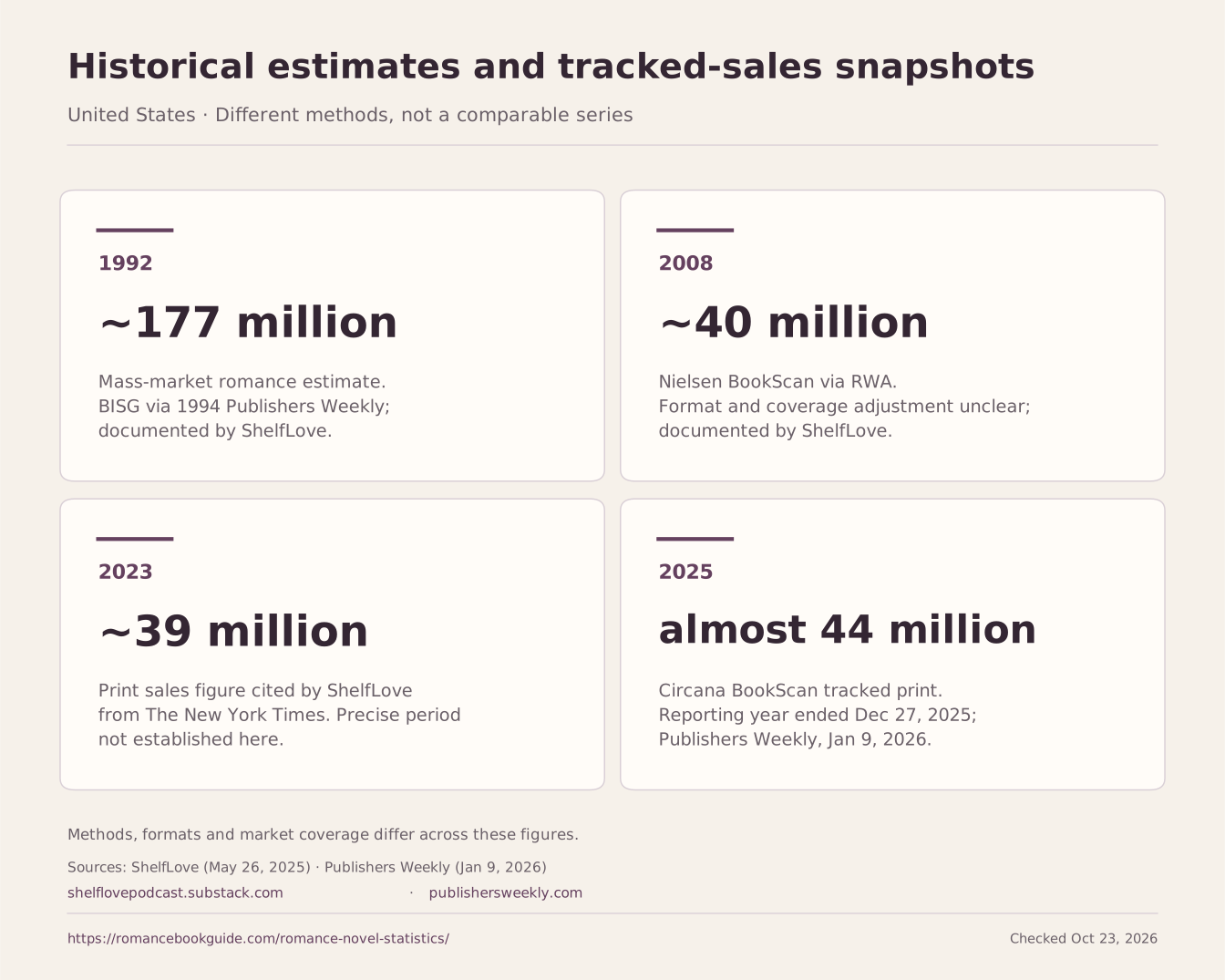
Historical romance-sales estimates were much higher than today's tracked counts. They come from different methods and retail coverage, though, so they cannot establish a clean all-time trend. The snapshots below keep that history visible without treating unlike measures as comparable bars.
Historical estimates and tracked-sales snapshots (U.S.; not a comparable series)
| Year | Copies | What it counts | Source | Label |
|---|---|---|---|---|
| 1992 | About 177 million | Mass-market paperback romance estimate extrapolated from industry sample data | BISG figures in a 1994 Publishers Weekly article, documented by Shelf Love | Dated · estimate |
| 2008 | About 40 million | Nielsen BookScan romance units; format scope and coverage adjustment unclear in the historical report | RWA's 2009 report, documented by Shelf Love | Dated |
| 2023 | About 39 million | Print-sales figure cited by Shelf Love from The New York Times; precise reporting window not established here | Shelf Love, secondary account | Dated |
| 2025 | Almost 44 million | Tracked print romance category, reporting year ended Dec. 27 | Circana via Publishers Weekly | Reported |
Graphic: Romance Book Guide. Historical figures from Andrea Martucci's research at Shelf Love; 2025 from Circana BookScan via Publishers Weekly. Different methods and coverage; not a comparable series.
One clear change is the decline of the cheap paperback. Mass-market paperback sales across all genres fell from 131 million copies in 2004 to 21 million in 2024. In December 2025, Publishers Weekly reported that ReaderLink would stop distributing the format at year-end. Ebooks and Kindle Unlimited offer other ways to read, but these figures do not measure how much paperback reading moved there. Harlequin's own ads in 1982 claimed U.S. romance paperbacks sold around 250 million copies a year. That's a marketing claim documented by Shelf Love, not an independently checked total, which is why it isn't in the graphic.
How big is the romance market in dollars?
We did not verify a current public total for what Americans spend on romance across print, ebooks, audio and subscriptions. The familiar "$1.44 billion" is not a current measurement. Andrea Martucci's historical source review traces the roughly $1.4 billion claim to an RWA report from 2012 and the last refresh of RWA's market-size figures to 2013. That predates BookTok and much of today's digital-reading market.
For a concrete sense of scale: 44 million tracked print copies at an assumed average paid price of US$12–18 would imply about US$530–790 million in retail spending. We did not verify that average price. This is an illustration for the tracked print copies, not a measured value for print or the whole romance market.
| Piece | What the calculation can support | Result |
|---|---|---|
| About 44 million copies × an assumed US$12–18 actually paid; the unit count is reported, the price assumption is ours. | US$528–792 million, or roughly US$530–790 million, conditional on that price. | |
| Audiobooks | The APA's publisher survey reports US$2.43 billion in 2025 revenue across all genres. Its public release names romance among the leading genres but does not give a romance-only dollar total. | Cannot add a verified romance amount to the print illustration; publisher revenue is also a different measure from retail spending. |
| Ebooks and Kindle Unlimited | We did not verify a complete public romance total. Amazon's KU documentation describes royalties based on eligible pages read, not a genre-specific retail-sales total. | No verified amount to add. |
Adding an assumed audio share and a guessed ebook subtotal would produce a precise-looking number without establishing total consumer spending.
What's counted, and what isn't:
| Counted (with limits) | Not established by those reports |
|---|---|
| Print copies at outlets that report to BookScan (copies, not dollars) | A complete total of self-published ebook sales |
| Publisher-reported digital sales in Circana's PubTrack Digital service | All independently published ebook sales or Kindle Unlimited reading by genre |
| Total audiobook revenue in the APA's publisher survey: US$2.43 billion in 2025 | Romance's current dollar total in that public release |
| Total OverDrive digital checkouts, all genres: 820.5 million in 2025, worldwide | A romance-only total, or every library service's borrowing |
| These reports' stated sales and lending channels | A complete combined count covering serial/app reading, used books and direct author sales |
If you read through a subscription, our Kindle Unlimited romance books guide explains why a Kindle ebook isn't automatically part of Kindle Unlimited.
Who reads romance novels?
The widely quoted reader profile, 82% women with an age band of 35 to 39, comes from a 2017 survey of 2,000 romance readers. Romance Writers of America commissioned NPD (now part of Circana) to run it. We found no newer public profile with equivalent sampling that establishes today's reader population. The newer survey below also has 2,000 respondents, but it answers a different question.
The 2017 profile, and how to use it
From RWA's summary of the December 2017 survey:
| Finding | Result |
|---|---|
| Gender | 82% women, 18% men |
| Age band reported as "average age" | 35 to 39; not a precise numerical mean |
| Race and ethnicity | 73% white, 12% Black, 7% Latino, 4% Asian |
| Formats used | 92% read print, 64% read ebooks, 35% listen to audiobooks |
| Subscription use | 15% used a subscription service |
The format numbers overlap. Plenty of readers do all three, so they add up to more than 100%. RWA set age and gender quotas from a nationally representative sample of book buyers who said they were likely to read romance. The survey was taken in December 2017; its public summary does not specify country coverage. An "average age 42" claim from a different study should not be substituted for this survey's reported band.
What's changed since then? Circana said in 2023 that new, younger readers drove the post-2020 boom, with BookTok and TV adaptations leading discovery. Longtime names like Nicholas Sparks, Debbie Macomber, Nora Roberts and Julia Quinn lost ground to newer authors such as Lucy Score, Ana Huang and Ali Hazelwood. In its June 2025 release, Circana reported that 26% of romance book buyers said they were reading "much more" than a year earlier. The public release does not give that study's sample size or field dates.
What romance readers say they like (2025)
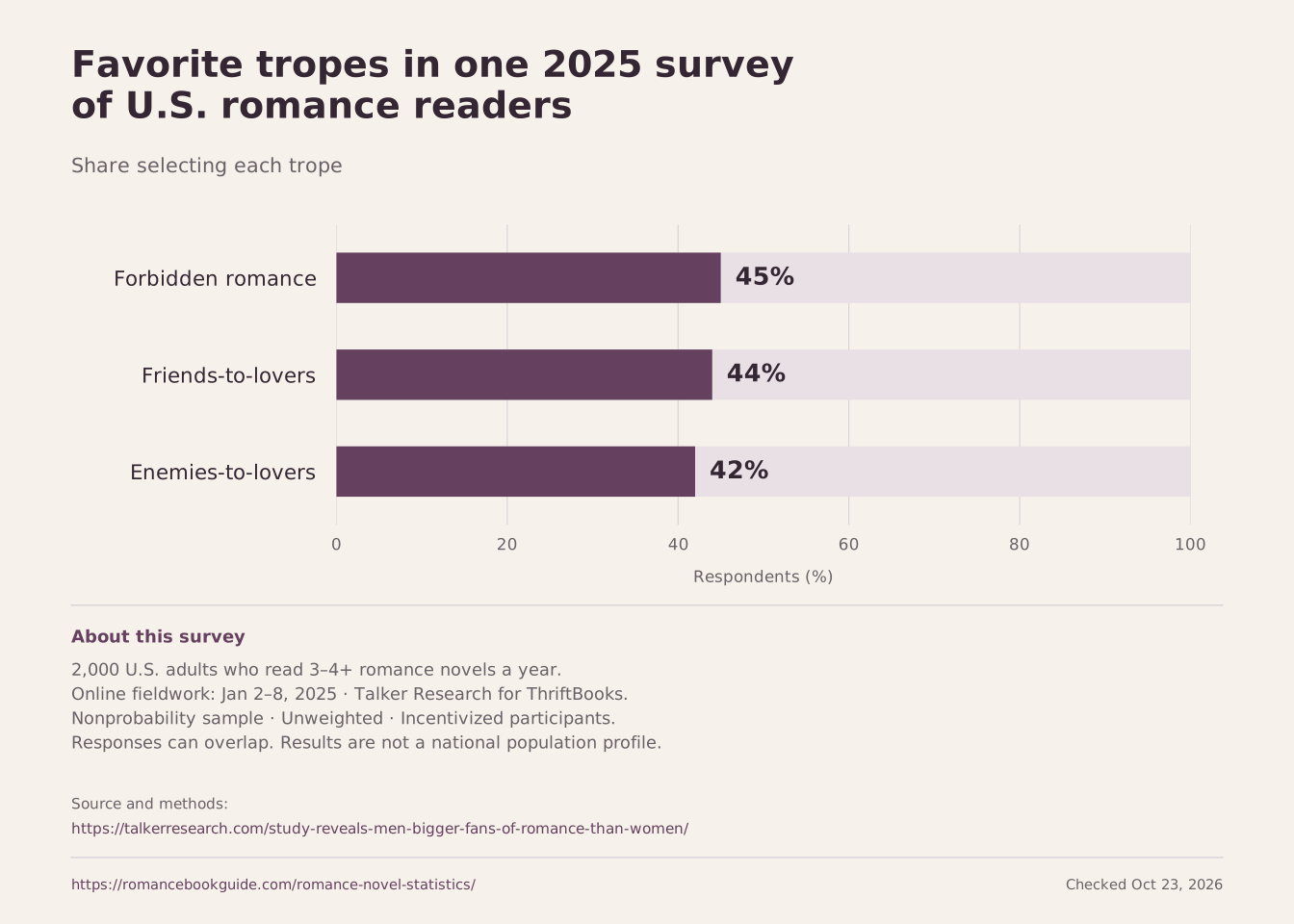
A trope is a familiar story pattern, like enemies-to-lovers, where two rivals fall for each other. In a 2025 survey, readers' top three picks were forbidden romance, friends-to-lovers and enemies-to-lovers, all within three points of each other.
Chart: Favorite tropes in one 2025 survey of U.S. romance readers
| Trope | Picked it as a favorite |
|---|---|
| Forbidden romance | 45% |
| Friends-to-lovers | 44% |
| Enemies-to-lovers | 42% |
Survey by Talker Research for ThriftBooks: online, January 2–8, 2025, 2,000 U.S. adults who read at least three or four romance novels a year. The percentages overlap; they are not parts of a single pie. Chart: Romance Book Guide.
The same survey found the least-liked tropes were love triangles (23%), office romances (22%) and fake dating (21%). Two cautions. First, the published summary does not establish whether one- or two-point gaps between tropes are statistically meaningful. Second, the survey was paid for by a bookseller. Talker's methodology describes incentivized, non-probability online recruitment, quotas, English-language interviewing unless noted, and unweighted data; it is not a random sample of all Americans. Headlines said "men are bigger romance fans than women," based on 63% of men and 60% of women calling themselves die-hard fans. But the survey only asked people who already read romance. It tells you nothing about how many men read romance.
The most popular answer doesn't have to be yours. Say you can't stand love triangles but would happily read three marriage-of-convenience books in a row. Our marriage of convenience romance books guide shows how differently one trope can play out from book to book.
What we still don't know about readers
- A verified current, nationally representative profile of all romance readers: age, gender and income.
- A verified public profile covering the full population of Kindle Unlimited romance readers.
- An all-market profile of who writes romance. The Ripped Bodice's 2019 study found that 8.3% of more than 2,400 romance titles from 18 studied publishers were by authors of color. Later updates exist, including coverage of 2024, but publisher samples are not a census of all romance writers, including independently published authors.
Romantasy, dark romance, hockey romance and BookTok
In its June 2025 release, Circana named romantasy and sports romance among the fastest-growing romance subjects, each with triple-digit growth, alongside romantic suspense and contemporary romance. Dark romance authors were among the fastest risers. BookTok (the book community on TikTok) was also one of the leading discovery routes identified in Circana's earlier account of romance's growth.
- Romantasy. A Circana analyst called it the highest-growth category in the whole U.S. print market in 2024 (NPR). Onyx Storm set an adult-title opening-week record in January 2025. Bloomberg's July 2024 reporting projected US$610 million for 2024, versus US$454 million in 2023; the projection is not a year-end result.
- Dark romance. These are love stories built around darker themes and morally gray leads, often with intense content. Circana named H.D. Carlton, Rina Kent and Elsie Silver among 2025's fastest-growing romance authors. It linked the trend to growth in psychological thrillers (+29%), dark fantasy (+23%) and horror (+13%). In BookNet's comparable-store analysis, sales assigned to the new "dark romance" category code grew by more than 100,000% in 2025. BookNet says the code's introduction in 2024 explains part of the increase. It measures sales assigned to that code, not the number of readers.
- Hockey and sports romance. Heated Rivalry ranked No. 6 in Circana's year-to-date list published April 14, 2026. The ABA's weekly romance bestseller list is a separate view of sales at participating independent bookstores; it is not the whole U.S. market.
- BookTok. Print sales for authors Circana tags as BookTok authors grew about 20% in 2024, their fifth straight year of growth. In the UK, nearly 15% of romantasy purchases in 2024 were discovered through video-sharing sites, up from 10% the year before and 5% in 2021 (NIQ). "Discovered" is the key word: that's where buyers first heard of a book, not proof the video caused the sale. And it covers romantasy, not all romance.
- LGBTQ romance. Sales reached 1 million units in the 12 months ending May 2023, up 40% (Circana). The release does not explicitly state the format coverage.
Trends tell you what's popular, not what you'll love. A hockey romance and a quiet Regency courtship can both be exactly right, just on different nights. If you came for the numbers and now want a book, our guides to Regency romance books and clean romance books start with the details that change your pick: setting, relationship, how much intimacy is on the page, and the ending.
Popularity is a crowd's answer. Your next book is a personal one. The Next Chapter, Romance Book Guide's email letter, sends romance recommendations, new guides and occasional news about books Romance Book Guide publishes, with your tastes in mind. You can unsubscribe any time.
Romance outside the U.S.: Canada and the UK
Canada's romance sales were still growing in early 2025, up 9% in the first half of the year. The UK went the other way: its Romance & Saga category hit a spending record in 2024, then sold 15% fewer copies in 2025. Each country measures differently, so keep these numbers separate from the U.S. figures.
Canada
BookNet Canada tracks Canada's English-language trade print book market. Its findings:
- 2024: the narrower Fiction / Fantasy / Romance category rose 82% over 2023; Fiction / Romance / Fantasy rose 175%. These are separate classifications, not a single all-romance total (BookNet's detailed report).
- First half of 2025: romance up 9%. Fiction / Romance / Fantasy rose 111% versus the first half of 2024, and sports romance was up 294%. Paranormal romance fell 49% and workplace romance fell 33%.
- Since then (BookNet, April 2026): romance sales peaked in the first quarter of 2025 and slipped through the second and third quarters. In a Q1-to-date snapshot presented in March 2026, romance accounted for about 9% of print units sold by a fixed group of comparable retailers, not the whole market or the full SalesData panel (original transcript). BookNet tied part of the early-2026 attention to Heated Rivalry.
Growth and share answer different questions. Growth compares romance with itself a year earlier. Share compares romance with everything else sold. A genre can gain share while selling fewer books, if the rest of the market falls faster.
UK and Ireland
NIQ BookScan tracks the UK print market under a category called Romance & Saga. This is not a count of every title marketed as romantasy; NIQ also discusses major romantasy authors within science fiction and fantasy. The table below is UK-only. Per NIQ data reported by The Bookseller in February 2026:
| Period | Copies | Change | Spending | Change |
|---|---|---|---|---|
| 2012 (old peak) | 15.35 million | £68.2 million | ||
| 2024 | Second-best year on record | Highest on record, about £1 million above 2012 | ||
| 2025 | 9.9 million | Down 15.4% | £63.5 million | Down 8.2% |
| 2026, first five weeks | About 800,800 | Down 11.2% | £5.3 million | Up 5.8% |
Notice that the reported early-2026 spending rose while copies fell: average spending per copy was higher, without establishing why. Copies and spending can move in opposite directions, so say which one you mean. For Ireland, NIQ's annual review says Romance & Sagas also fell short in 2025; it does not provide an equivalent romance-only numerical table.
Audiobooks, libraries and Kindle Unlimited
Romance is a big audiobook genre. Publishers reported romance audiobook revenue up 30% in 2024, the biggest reported genre increase (APA's 2025 release). In 2025, romance stayed among the top genres by audiobook revenue. The public 2025–2026 APA releases checked here do not give a romance-only dollar total.
- Audiobooks. Audiobook sales revenue in the APA's publisher survey hit US$2.22 billion in 2024 and US$2.43 billion in 2025. In its 2026 consumer survey, 58% of U.S. adults aged 18 and over said they had ever listened to an audiobook. Romance was named among the top revenue genres, alongside science fiction/fantasy and mysteries/thrillers/suspense; general fiction had the largest share.
- Libraries. People borrowed 820.5 million ebooks, audiobooks and magazines through OverDrive's services in 2025, a worldwide total covering public libraries, schools and other institutions (OverDrive). Romance and romantasy titles appeared in its global top-ten checkout lists, but the release does not provide a romance-only checkout total.
- Kindle Unlimited. We did not verify a public Amazon total showing how much Kindle Unlimited reading is romance. Amazon's royalty rules explain payment by eligible pages read, not a romance-only total. Written Word Media's monthly fund tally adds to US$699.9 million for 2025, worldwide and across all genres, excluding separate All Stars bonuses. We could not recheck all twelve monthly announcements against Amazon's originals; the tally is author royalties, not U.S. romance spending.
- Ebooks. Circana's PubTrack Digital service uses publisher reporting. We did not verify a complete public count that also covers self-published romance ebooks.
Bookstores, paperbacks and the people behind the old numbers
Romance-focused bookstores have expanded quickly. The American Booksellers Association counted 157 romance-focused member stores in 2025, and more than half had opened in the previous two years. Meanwhile, the cheap paperback that carried romance for decades is disappearing, and the group behind many of the old romance statistics has shrunk.
- Bookstores: two counts, two definitions. The ABA's 157 includes member stores that focus on romance (AP, July 2025). An independent tally by Lady Jane at Romancing the Data, updated April 12, 2025, identified 59 physical U.S. romance-focused bookstores operating by the end of 2024, compared with four in 2022. These differently dated counts should not be treated as a single comparable series.
- Paperbacks. As above: 131 million mass-market copies in 2004, 21 million in 2024, and about 15 million through October 2025, across all genres (Publishers Weekly).
- Romance Writers of America. The trade group behind many of the "romance industry" figures still circulating filed for Chapter 11 bankruptcy in May 2024. By the May 2024 filing, its membership had fallen from about 10,000 before 2019 to about 2,000, according to court filings (Publishers Weekly). Its widely recycled 2017 reader profile predates both this contraction and the recent romance boom.
Seven romance statistics to stop citing
These seven numbers keep turning up in articles, on stats pages and in social posts. Each one is outdated, misapplied or has no source you can trace. Here's where each came from and a better line to use instead.
| What you'll see | Where it came from | What's wrong | Say this instead |
|---|---|---|---|
| "Romance is a $1.44 billion industry." | Older RWA reports, examined by Shelf Love | Dated; not a verified current all-format total | "Circana BookScan tracked almost 44 million U.S. print romance sales in 2025. A complete current all-format dollar total was not verified." |
| "A third (or half, or a quarter) of all books sold are romance." | A 1992 paperback-only share, old RWA claims and a 2016 fiction-only figure | These do not establish today's share of every book sold | "About 5.8% of the print units tracked in Circana/PW's 2025 report were romance." |
| "82% of romance readers are women, and the average reader is 35 to 39." | RWA/NPD survey, fielded December 2017 | Dated; its age band is not a precise mean, and a newer survey's equal sample size does not make its sampling equivalent | "In the 2017 RWA/NPD survey of 2,000 romance readers, 82% of respondents were women." |
| "Romance sales grew 52%." | Circana, 12 months ending May 2023 | True for that window; not a current growth rate | "Tracked print romance grew 52% in the 12 months ending May 2023, rose 3.9% in the 2025 annual report, and fell 8.6% in the nine-month 2026 report." |
| "Romance is bigger than it's ever been." | Trend stories; historical claims examined by Shelf Love | Different formats, periods and measurement methods prevent a clean all-time comparison | "Historical estimates were much higher, but they are not a comparable series with today's tracked print totals." |
| "Colleen Hoover and Emily Henry make up 80% of romance sales." | Circana's original 2023 author-share chart, attached to its July 10 release | The source exists: 48% plus 32%. The error is treating that dated print-market snapshot as a current all-format share | "Circana's 2023 chart reported Hoover at 48% and Henry at 32% of its tracked romance print volume for the preceding 12 months." |
| "Ebooks are 60% of romance sales." | Stats sites; no supporting original for that all-market share was verified here | The period, coverage and denominator are missing | "We did not verify a current ebook share covering the full romance market." |
Andrea Martucci at Shelf Love has investigated the history of romance's bad data. Her essays on the billion-dollar claim and print sales history are worth reading in full.
How to cite a romance statistic
A good citation keeps five things together: the number, what it counts, the country, the time period and the source. Link to the original report when you can. When a trade publication is reporting someone else's data, name both, as in "Circana data, reported by Publishers Weekly."
What each kind of number can and can't tell you:
| Kind of number | Good for | Can't tell you |
|---|---|---|
| Copies sold | How many books a sales tracker recorded | How many people read them, or how many finished |
| Dollars spent by shoppers | Spending in the tracked stores | What publishers earned, what authors earned, or growth after inflation |
| Growth rate | Change within one category, set of stores and period | How a typical author is doing, or how a new book will sell |
| Share of the market | Romance's slice of a stated total | Anything outside that total, such as ebooks in a print share |
| Survey percentage | What that group of people said | How many romance readers exist overall |
| "Discovered through" | Where buyers first heard of a book | Whether that platform caused the sale |
That table also answers a question many writers ask: romance selling well as a genre says almost nothing about what one romance author earns. Category growth can come mostly from a handful of very big books.
Ready-to-use sentences:
- Circana BookScan tracked almost 44 million U.S. print romance sales in the reporting year ending December 27, 2025, up 3.9% versus the comparable 2024 period, according to Publishers Weekly.
- Tracked U.S. print romance sales fell 8.6% in the nine-month period ending October 3, 2026, compared with the corresponding 2025 period, according to Circana BookScan data reported by Publishers Weekly.
- Romance made up about 5.8% of the U.S. print units in Circana/PW's 2025 report, roughly 1 in 17, by Romance Book Guide's calculation from 44 million ÷ 762.4 million tracked copies.
- In a January 2–8, 2025 online survey of 2,000 U.S. adults who read at least three or four romance novels a year, 45% named forbidden romance as a favorite trope (Talker Research for ThriftBooks).
To credit this page:
Romance Book Guide Editorial. "Romance Novel Statistics: What the Numbers Really Say in 2026." Romance Book Guide. Last checked October 2026.
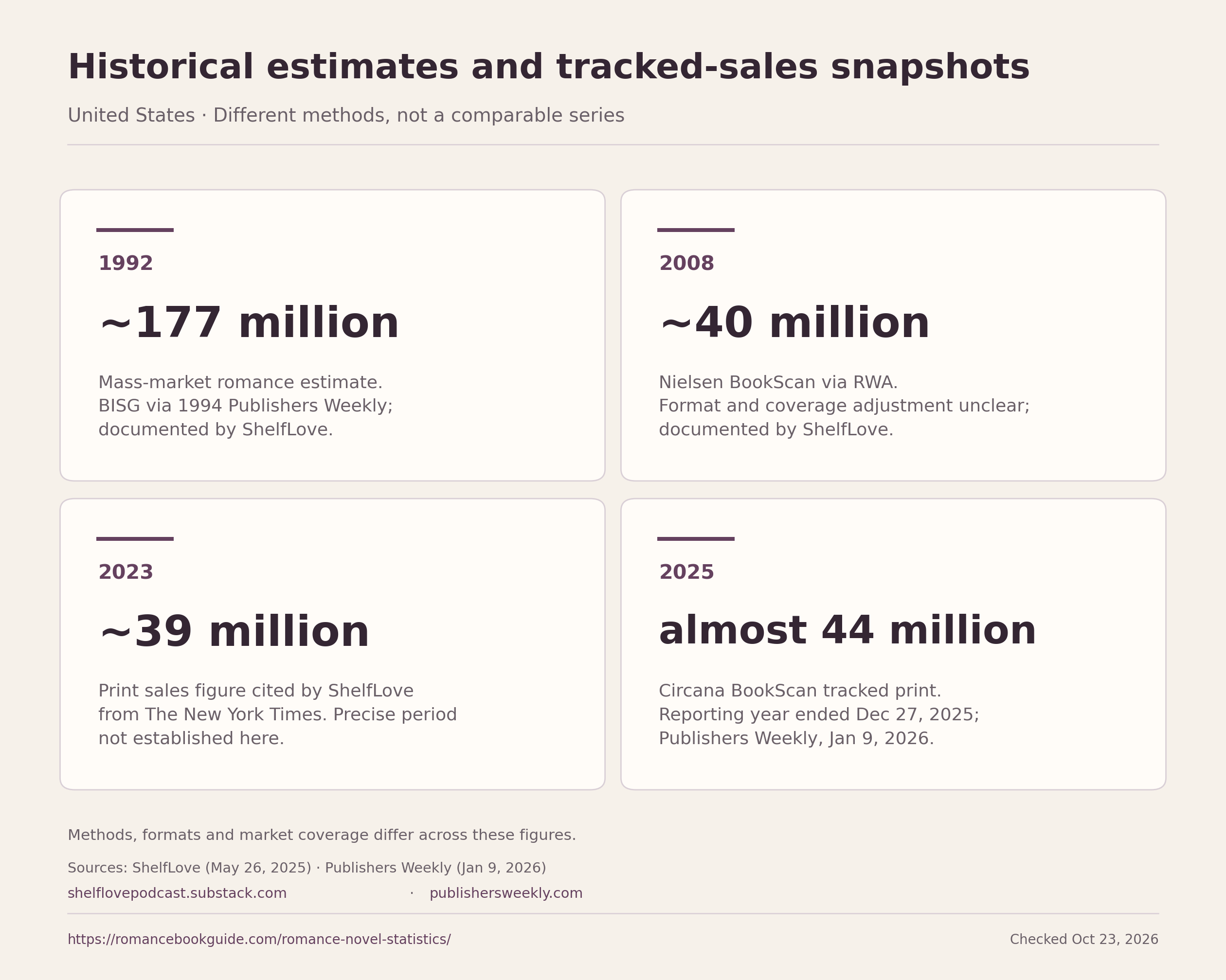
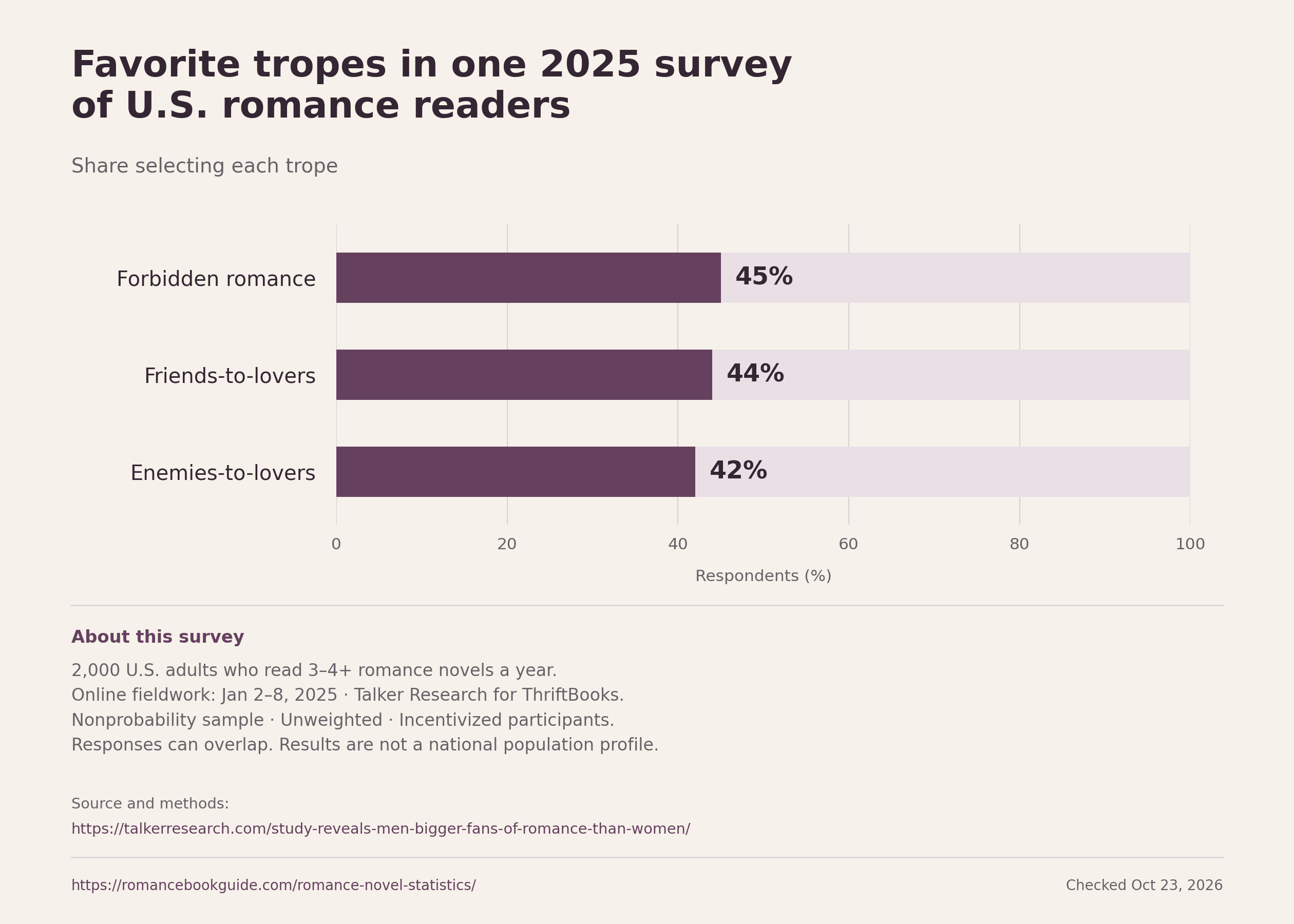
You're welcome to cite any number here; a link back helps readers check the context. Please keep the original source's name with the number, too. Circana, NIQ, BookNet and the others did the measuring. Our part is the comparison and the explanation. You can also download the at-a-glance table as a CSV spreadsheet file, the historical snapshots (SVG · PNG), and the trope chart (SVG · PNG), with credits included.
How we checked these numbers
We checked the linked reports on October 23, 2026, recorded their periods and distinguished direct evidence from secondary reporting and assumptions. When a figure only reached us secondhand, we say so. When sources differ, we identify the difference and say where it remains unresolved.
Romance Book Guide helps you find romance books that feel like your kind of love story — comparing real books by setting, relationship, content level and ending, with the author or publisher information behind every pick, so you can choose your next read with confidence. For this page, we used the same habit on sales reports and reader surveys: show the source, show the date, show the limits.
Research note
- What we checked:
- Circana press releases from 2023 and 2025
- Circana sales data as reported by Publishers Weekly and Publishers Lunch (2024–2026)
- The Audio Publishers Association's 2025 and 2026 releases, and OverDrive's 2025 results
- American Booksellers Association figures as reported by AP and WBUR, plus an independent bookstore tally
- BookNet Canada's 2025 and 2026 reports, NIQ's public annual reviews, and the accessible teaser for The Bookseller's detailed UK report
- NIQ's 2025 romantasy survey summary, Talker Research's 2025 survey release for ThriftBooks, and Romance Writers of America's published 2017 survey summary
- Reporting on RWA's 2024 bankruptcy and The Ripped Bodice's diversity research, plus Shelf Love's historical research
- Check date: October 23, 2026, for every source.
- What reached us secondhand:
- Bloomberg's dated romantasy projection, read in its authorized syndication
- The Kindle Unlimited fund total, summed from Written Word Media's monthly table; all twelve Amazon originals could not be rechecked
- The historical 1992, 2008 and 2023 figures documented by Shelf Love
- What we did not verify:
- A complete reconciliation of Circana's rolling and annual romance totals
- A complete current ebook, Kindle Unlimited or worldwide romance total
- The full subscriber text of The Bookseller's February 12, 2026 article: its detailed UK figures remain attributed to that report; we could inspect its date and 800,794-copy teaser
- The current primary Ripped Bodice report/chart, which was inaccessible; later coverage confirms that updates after 2020 exist
- Private sales data, which we don't have access to
- What's ours: every "Our math" figure shows its calculation. The print-spending illustration, annual back-calculations and 2026 scenario are conditional on the assumptions shown, not measured market totals or a forecast.
- Tools: we may use software, including AI tools, to help organize research and drafting. Romance Book Guide remains responsible for everything we publish.
Romance Book Guide is operated by Kozi Publishing LLC. Read how we check and describe evidence and our publishing and commercial disclosures. Spotted a number that's wrong or out of date? Suggest a correction with a source.
Questions people still ask
How many romance novels are published each year? We did not verify a current public count covering every traditionally and independently published romance title. A useful count must distinguish unique works from editions and formats, define romance, name the country and year, and explain which publishers or platforms it includes. A catalog's results count alone does not establish that total.
What's the best-selling romance novel of all time? We did not verify a comparable all-time ranking. Publishers announce lifetime sales in different ways: worldwide or U.S.-only, all formats or print, single books or whole series. Those numbers can't be fairly compared. One well-documented record is Onyx Storm's adult-title opening week at BookScan: Publishers Lunch reported 1,288,300 hardcovers in January 2025.
How much romance is self-published, or read through Kindle Unlimited? We did not verify a complete public percentage for either. Self-published print sold through reporting retailers can appear in BookScan, while ebook-platform sales and Kindle Unlimited page reads are different measures. Amazon's KU royalty documentation explains eligible-page payments but does not provide a romance share. An estimate needs its own source, date and method.
Are these numbers for the U.S. or the whole world? The main sales figures are U.S.-only. Canada and the UK have their own section and labels, and OverDrive's library total and the KDP fund tally are worldwide. Survey coverage is stated separately; RWA's public 2017 summary does not specify its country coverage.
Where to go next
If you came for a number, you've got it, with the source attached. If you came because you love romance, the more useful question is what you want to read next. Start with the detail that matters most to you:
- Clean romance books for love stories without explicit sexual scenes
- Clean Regency romance books for historical courtship with the door closed
- Regency romance books for a wider historical shelf at different content levels
- Marriage of convenience romance books for couples who say "I do" before they fall in love
- Kindle Unlimited romance books if you'd rather borrow than buy
Not sure what you're in the mood for? Build your reading brief: answer four quick questions and get a short summary of your tastes to use anywhere you shop for books. It doesn't recommend specific titles.
Sources
Checked October 23, 2026. The research note above identifies secondary reporting and the full-text access limits.
- Circana. "Another Year of Romance, with a Dark Twist." June 4, 2025.
- Circana. "From Laggard to Leader: Record Sales of Romance Books Reflect Next Generation of Contemporary Readers." July 10, 2023; original author-share graphic attached to the release.
- Circana. LGBTQ fiction sales release. June 6, 2023.
- Circana, via infoDOCKET. 2024 book sales results. January 22, 2025.
- Circana. Books: BookScan coverage and PubTrack Digital.
- Circana. Top 10 books: the year-to-date list published April 14, 2026. This is the period used for Heated Rivalry's No. 6 rank.
- Publishers Weekly. "Print Book Sales Rose Slightly in 2025." January 9, 2026.
- Publishers Weekly. "Print Book Sales Saw a Small Sales Increase in 2024." January 10, 2025 online; January 13 print issue.
- Publishers Weekly. "Print Book Sales Dip 0.9% in First Nine Months of 2025." October 10, 2025.
- Publishers Weekly. "First Quarter Print Sales Fell 3.1%." April 2, 2026 online; April 6 print issue.
- Publishers Weekly. "Print Sales Stay Flat Through September." October 13, 2026; reporting period ended October 3.
- Publishers Weekly. "Last Call for Mass Market Paperbacks." December 12, 2025 online; December 15 print issue.
- Publishers Weekly. "Romance Writers of America Files for Bankruptcy." May 30, 2024 online; June 3 print issue.
- Publishers Lunch. "Onyx Storm Sets BookScan Record." January 30, 2025.
- Harlequin. Heated Rivalry, Rachel Reid: paperback edition, ISBN 9781335534637. November 26, 2024 edition.
- NPR, via WFAE. "Readers flock to fantasy and dark romance love stories." June 29, 2025.
- Bloomberg, syndicated by The Straits Times. Romantasy market report and 2024 projection. July 2024. The article's headline uses Singapore dollars; this page identifies the U.S.-dollar figures in its text.
- Audio Publishers Association, via infoDOCKET. 2025 survey results covering 2024 revenue. June 2, 2025.
- Audio Publishers Association. Survey results: 2025 sales and 2026 consumer listening. June 2026 release; also reported by Shelf Awareness on June 8, 2026.
- OverDrive. 2025 digital lending results. January 21, 2026.
- Amazon KDP. Kindle Unlimited royalty rules.
- Written Word Media. KDP Global Fund monthly payouts. Third-party monthly table; 2025 figures summed for this page.
- Associated Press. Report on romance bookstores and reader communities, including the ABA's 157-store count. July 2025; later WBUR coverage, September 24, 2025.
- Lady Jane, Romancing the Data. "The Rise of Romance Bookstores." Updated April 12, 2025; revised physical-store tally.
- American Booksellers Association. Indie Romance Bestseller List. Weekly independent-bookstore sales list.
- BookNet Canada. "Discounts, data & decisions: Navigating hesitant consumer spending." June 12, 2025; distinguishes Fiction / Fantasy / Romance from Fiction / Romance / Fantasy.
- BookNet Canada. "Subjects on the move in the Canadian market." August 11, 2025.
- BookNet Canada Tech Forum. "Trendspotting: Book subjects on the move in the Canadian market." March 30, 2026 transcript; April 7 summary.
- The Bookseller. "Ice and spice: romance sales are running hot and cold as the year develops." February 12, 2026. Full article requires sign-in; the research note above records the access limit.
- NIQ. "Dragons and magic and fae, oh my." August 11, 2025.
- NIQ. "Bestsellers and trends: UK and Ireland 2025." 2026 annual review.
- Talker Research for ThriftBooks. Romance reader survey. January 30, 2025; methodology.
- Romance Writers of America. About the romance genre: 2017 reader survey summary.
- MPR News. "Who is reading romance novels?" June 13, 2016.
- Publishers Weekly. "New Survey Finds Little Improvement in Diversity in Romance Publishing." 2020 coverage of The Ripped Bodice's 2019 study; later coverage mentioning the 2024 report, November 14, 2025.
- Andrea Martucci, Shelf Love. "The Data Does Not Exist to Support 'Romance is a Billion Dollar Industry.'" January 22, 2024.
- Andrea Martucci, Shelf Love. "Actually, Romance Novel Print Sales are Down." May 26, 2025.